Updated 6 June 2026 · Reviewed by IFRS Buddy Editorial Team
What are the new subtotals and income statement categories required by IFRS 18?
U
IFRS 18 New Subtotals and Categories — Core Rule
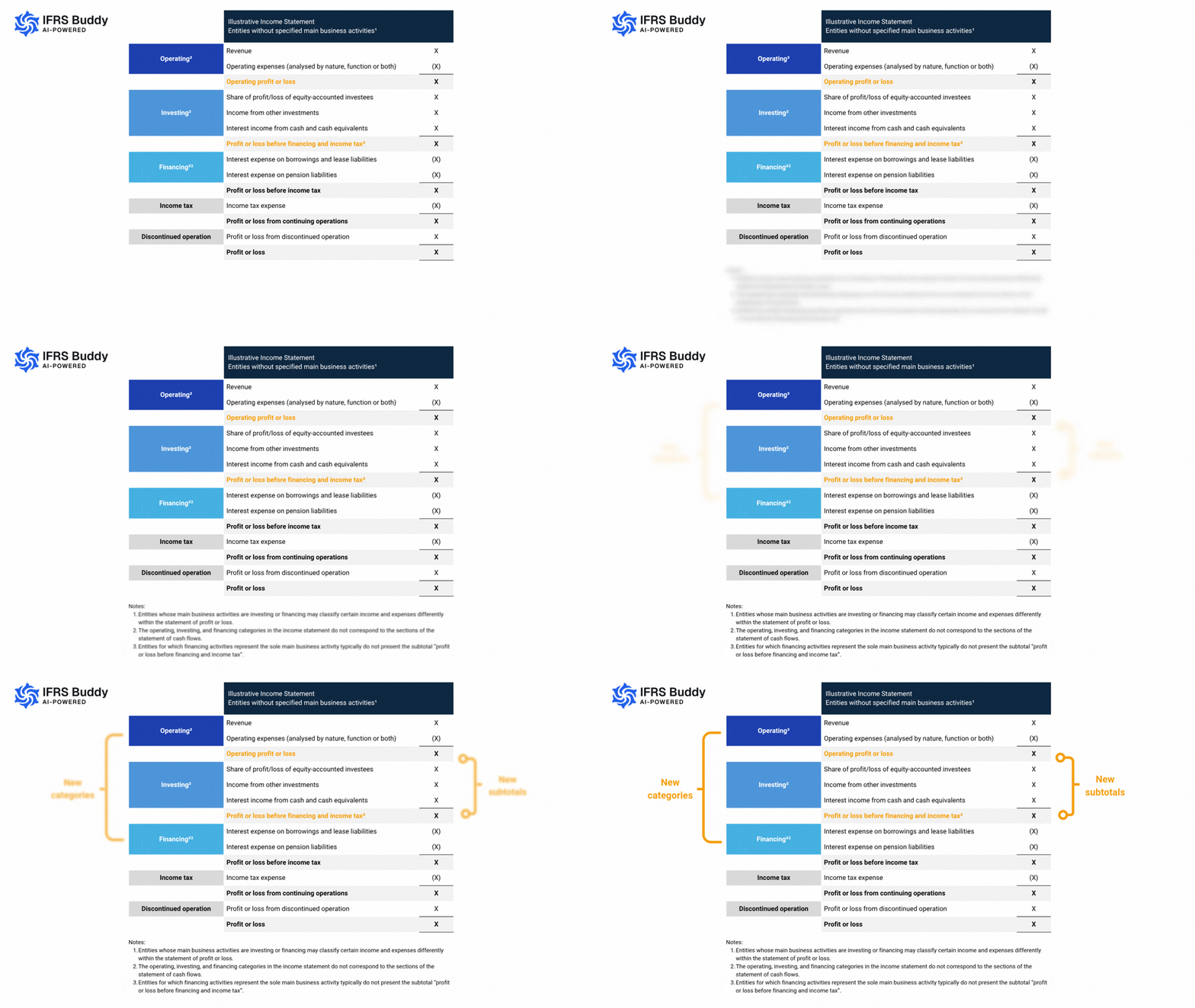
IFRS 18 Presentation and Disclosure in Financial Statements (effective 1 January 2027, replacing IAS 1) mandates three defined categories in the statement of profit or loss — operating, investing, and financing — and introduces two new mandatory subtotals: operating profit and profit before financing and income tax, creating a standardised structure that eliminates the current diversity in how entities present income and expense.
Click to enlarge
How IFRS 18 New Subtotals and Categories Works
Three mandatory categories (IFRS 18.39): IFRS 18 classifies all income and expenses into three mandatory categories — operating, investing, and financing. The operating category is the residual — any income or expense that does not meet the criteria for investing or financing is classified as operating (IFRS 18.53). Income taxes and discontinued operations remain separate sections of the statement under existing standards (IAS 12 and IFRS 5), not IFRS 18 categories.
Investing category captures income and expenses from assets that generate a return independently of the entity's main business activities — for example, dividends from equity investments not accounted for under the equity method, interest income from assets managed as investing activities, and fair value changes on such assets (IFRS 18.62–18.65). Not all interest income is automatically investing — the classification depends on whether the underlying asset is managed as an investing asset.
Financing category captures income and expenses arising from liabilities that represent a source of finance — principally interest expense on borrowings, effects of changes in financing liabilities, and unwinding of discount on liabilities that are financing in nature (IFRS 18.70–18.74). It does not encompass all derivative fair value changes or all provisions — only those arising from liabilities that constitute a source of finance. This distinction between financing liabilities and investing assets is critical.
Two mandatory subtotals must appear on the face of the statement (IFRS 18.82): (1) operating profit — totals the operating category (the new "below gross profit, above investing income" landmark); and (2) profit before financing and income tax — operating profit plus the investing category total. These subtotals are required, not optional, and cannot be relabelled or omitted.
Equity-method entities (associates/JVs) are a special case: their share of profit or loss must be classified as investing unless the investee's activities are integral to the entity's own operations (the "integral associate" concept), in which case it sits in operating (IFRS 18.67–18.69). This will require careful judgement for conglomerates and financial services groups.
Management performance measures (MPMs): Any subtotal of income or expenses that management communicates publicly and that is derived from an IFRS total or subtotal in the statement of profit or loss must be disclosed in the notes with a reconciliation to the nearest IFRS subtotal, the tax effect, the non-controlling interests effect, and an explanation of why the measure is useful — ending the era of unchecked "adjusted EBITDA" presentations (IFRS 18.106–18.115).
IFRS 18 New Subtotals and Categories — Practical Example
Assume a manufacturing group, Altera GmbH, for the year ended 31 December 2027 (€ millions):
Line item
Category
Amount (€m)
Revenue
Operating
500
Cost of sales
Operating
(320)
Gross profit
180
Distribution & admin expenses
Operating
(60)
Operating profit *(mandatory subtotal)*
120
Dividend income from equity investments
Investing
8
FV gain on equity instruments at FVTPL
Investing
4
Profit before financing and income tax *(mandatory subtotal)*
132
Interest expense on bonds
Financing
(12)
Profit before tax
120
Income tax expense
Income taxes
(30)
Profit for the year
90
Transition note — reclassification is presentational only
IFRS 18 requires retrospective application and restatement of comparative periods (IFRS 18.C2). Reclassifications between the three categories are presentation reclassifications only — no journal entries are required. An entity that historically included interest income on surplus cash in operating activities would, on transition, restate prior-year comparatives with that amount shown in the investing line, with no change to ledger balances or retained earnings.
IFRS 18 New Subtotals and Categories — Common Pitfalls
Misclassifying interest on borrowings as investing: Interest on all borrowings — including revolving credit facilities — belongs in financing, not investing. Only returns on assets managed as investing activities qualify as investing income (IFRS 18.70). Conflating the two distorts the mandatory subtotals.
Assuming "operating profit" under IFRS 18 = prior IAS 1 subtotal: Many entities historically labelled a line "operating profit" that included or excluded items inconsistently. IFRS 18's operating profit is defined by exclusion — anything not investing or financing. Prior like-for-like comparisons will require careful footnote explanation.
Overlooking the integral associate test: Failing to assess whether an associate's activities are integral to operations may result in share of profit being misclassified as investing rather than operating, materially misrepresenting operating profit — a likely audit focus area in early adoption years.
Treating discontinued operations as an IFRS 18 change: IFRS 5 remains unchanged. Discontinued operations are presented in a separate section of the statement, as before, and are not affected by the new three-category structure.
IFRS 18 New Subtotals and Categories — Key Paragraphs
IFRS 18.39 — defines the three mandatory income and expense categories.
IFRS 18.53 — establishes operating as the residual category.
IFRS 18.62–18.65 — investing category definition and scope.
IFRS 18.70–18.74 — financing category definition, interest on borrowings.
IFRS 18.82 — mandatory subtotals: operating profit and profit before financing and income tax.