Updated 10 June 2026 · Reviewed by IFRS Buddy Editorial Team
What are the key differences between IFRS 18 and IAS 1 for financial statement presentation?
U
IFRS 18 vs IAS 1 — Core Rule
IFRS 18 Presentation and Disclosure in Financial Statements supersedes IAS 1 for annual reporting periods beginning on or after 1 January 2027 (IFRS 18.C1). While IAS 1 has governed financial statement presentation for decades, IFRS 18 introduces a more structured, principle-based framework that redefines how income and expenses are classified, disaggregated, and disclosed. The core objective remains unchanged — financial statements should provide information about an entity's assets, liabilities, equity, income and expenses that is useful to users (IFRS 18.1) — but the mechanics of achieving that objective are substantially redesigned.
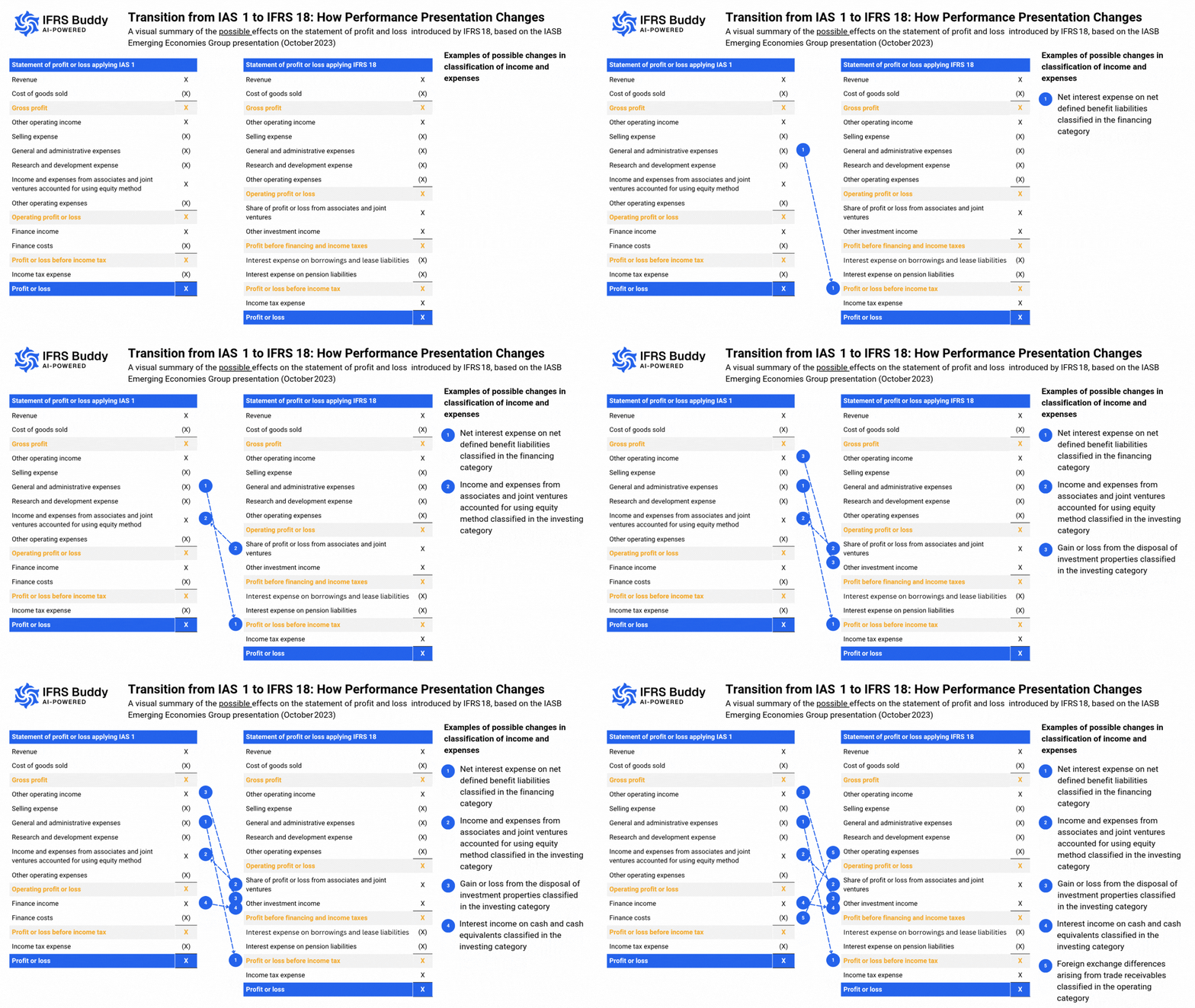
A visual summary of the possible effects on the statement of profit or loss introduced by IFRS 18
Click to enlarge
How IFRS 18 vs IAS 1 Works
Statement of profit or loss — new structure
Under IAS 1, entities had significant flexibility in how they presented income and expenses in the statement of profit or loss, with limited prescribed categories. IFRS 18 replaces that flexibility with a structured classification framework. Entities must present their statement(s) of financial performance as either a single statement or two separate statements, but in either case the profit or loss section must appear first (IFRS 18.12).
The key structural changes include:
Operating and financing categories — All income and expenses must be classified into defined categories. Operating activities cover income and expenses arising from the entity's main business activities; financing activities cover income and expenses from liabilities and equity financing. This distinction did not exist as a formal requirement under IAS 1.
Defined subtotals — IFRS 18 prescribes specific subtotals that entities must present in the statement of profit or loss, bringing consistency that was absent under IAS 1's more permissive approach.
Management-defined performance measures (MPMs) — IFRS 18 introduces a new disclosure requirement for subtotals or totals used by management in public communications that are not defined by IFRS Accounting Standards, requiring reconciliation and explanation. IAS 1 had no equivalent requirement.
What stays the same
Several foundational requirements carry across from IAS 1 with minimal change:
Entities must present each primary financial statement with equal prominence in a complete set of financial statements (IFRS 18.14).
Comparative information for all amounts reported in the current period remains mandatory, including narrative and descriptive information where necessary for understanding (IFRS 18.31).
Consistency of presentation must be maintained from one period to the next, unless a significant change in operations or a review of the statements makes a different approach more appropriate (IFRS 18.30).
Financial statements must be clearly identified and distinguished from other information in the same published document (IFRS 18.26).
Notes and disclosure
IFRS 18 formalises the roles of primary financial statements and notes more explicitly than IAS 1. The notes must provide material information to help users understand line items in the primary financial statements and to supplement those statements with additional information necessary to meet the overall objective (IFRS 18.17). Entities are required to disclose accounting policy information and information required by other IFRS Accounting Standards not presented in the primary statements (IFRS 18.113).
IFRS 18 vs IAS 1 — Common Pitfalls
Assuming IAS 1 formats carry forward — IFRS 18 requires a fundamental rethink of profit or loss presentation, not just cosmetic relabelling. Existing formats built under IAS 1 will almost certainly need structural revision.
Misidentifying operating vs. financing items — The classification is principles-based, but the principles are more prescriptive than IAS 1's flexibility. Applying cash flow definitions of operating and financing is incorrect — IFRS 18's categories are distinct.
Overlooking MPM disclosures — Any subtotal or performance measure used in public communications that is not defined by IFRS Accounting Standards will now trigger specific disclosure requirements. Entities that routinely communicate adjusted earnings figures need to prepare for this.
Transition reconciliations — On first application, entities must present a reconciliation for each line item in the comparative period's primary financial statements (IFRS 18.C3). This is a significant transition task that finance teams should plan for early.
Interim reporting — Special transition rules apply when an entity applies IAS 34 in the first year of applying IFRS 18 (IFRS 18.C5). Teams using IAS 34 for interim statements must understand these interim-period requirements separately.
IFRS 18 vs IAS 1 — Key Paragraphs
IFRS 18.1 — Sets out the overall objective of IFRS 18: to ensure financial statements provide relevant information that faithfully represents an entity's financial position and performance.
IFRS 18.12 — Requires entities to present their statement(s) of financial performance as either a single combined statement or two separate statements, with profit or loss always first.
IFRS 18.17 — Defines the role of the notes: to help users understand primary statement line items and to supplement those statements with additional material information.
IFRS 18.30 — Requires consistency of presentation, disclosure and classification from period to period, subject to limited exceptions.
IFRS 18.C1 — Confirms the effective date of 1 January 2027, with earlier application permitted.
IFRS 18.C3 — Requires a reconciliation for each line item in the comparative period when IFRS 18 is first applied, a key transition obligation for preparers.